
How to Take Notes on Research Papers You Can Use Months Later
You’ve read the paper. You know you read it: there’s a note that says “interesting!!” and three yellow highlights. What you can’t tell, six months later, is what it found.
Good notes fix that. For every paper you read past the first skim, write a short summary in your own words: the question, the method, the main result with its numbers, the limitations, and why it matters to your work. Keep that note next to the paper. Then, separately, write down any idea that connects several papers as its own note, because those are the notes that turn into chapters.
Below: a one-page template, literature notes versus permanent notes, a light Zettelkasten that suits a PhD, and where to keep it all so you can find it again.
Why most paper notes are useless six months later
Open the notes from your first year. For a lot of people they’re a few sentences copied from the abstract, some highlighted phrases, and that “interesting!!” in the margin. They prove you read the paper. They don’t say what it found, whether you believed it, or why you cared.
The trouble is who the notes are written for. You write them for the person reading the paper right now, who still has the whole thing in their head. They need to work for the person six months from now, who has forgotten everything, is drafting a literature review at 11pm, and needs to know whether this paper supports the claim in paragraph three.
Two rules fix most of this:
- Write in your own words. If you can’t paraphrase the result, you haven’t understood it yet, and that’s worth knowing now rather than in your viva.
- Record the numbers. “Improved accuracy” is useless. “Accuracy 87.2% vs 81.5% baseline on 1,200 test images” is a sentence you can cite.
If you’re still deciding how deeply to read each paper, start with how to read a research paper quickly; note-taking only pays off for papers that get past the first pass.
A note template for research papers
This template fits on one screen. The paper in it, like the others in this post, is made up for illustration. Copy it into whatever tool you use and fill it in after your second pass through a paper, not during the first read.
# Nguyen 2021 – Ceramic membrane fouling under ozone pretreatment

Citation: Nguyen, T. et al. (2021). <journal>, <volume>, <pages>.
DOI: <doi>
Read: 2026-11-12   Depth: second pass

Question: Does ozone pretreatment reduce fouling of ceramic membranes
in surface-water filtration?

Method: Bench-scale rig, 3 ozone doses, 30-day runs, natural river water.

Main result: Flux decline cut from ~40% to ~15% at the middle dose (Fig. 4).
Highest dose gave no extra benefit.

Limitations: One water source. No cost analysis. Bench scale only.

My take: Convincing for low-turbidity water. Doubt it holds for our
high-silt samples.

Use it for: Ch2 pretreatment section; possible baseline for experiment 3.

Key quotes / pages: p. 6 definition of "irreversible fouling".
What each field is for:
- Question is one sentence. If you can’t write it, re-read the introduction’s last paragraph, where most authors state their aim.
- Main result carries numbers and a figure or table reference, so you can find the evidence again in seconds.
- My take is where your judgment goes. Reviewers and examiners want to see that you evaluated sources, not just listed them, and this field is where that starts.
- Use it for links the paper to your own work: a chapter, an experiment, a grant section. It’s the field that makes notes findable by purpose rather than by author.
- Key quotes should be rare and always carry a page number. Copied text without a page number is a plagiarism risk waiting to happen.
Filling this in takes 10 to 15 minutes per paper. For a paper you only skimmed, write two lines (question and result) and stop.
Literature notes vs permanent notes
These terms come from Sönke Ahrens’s book How to Take Smart Notes, which describes the Zettelkasten method used by the sociologist Niklas Luhmann. The distinction is useful even if you never adopt the full system.
| Literature note | Permanent note | |
|---|---|---|
| About | One source | One idea |
| Written | While or just after reading | Later, when you see a pattern |
| Content | What the paper says, with pages | What you think, in full sentences |
| Sources | Exactly one | Often several |
| Example title | Nguyen 2021 – ozone pretreatment | Pretreatment helps only for low-turbidity water |
The template above is a literature note. A permanent note looks like this:
Ozone pretreatment helps ceramic membranes mainly for low-turbidity water. Nguyen 2021 found a large drop in flux decline with river water at about 5 NTU. Park 2019 saw almost no benefit at 60 NTU. Silva 2023 suggests the difference is particle size, not ozone dose. If that’s right, our silt-heavy samples won’t benefit, which is worth testing directly in experiment 3.
That paragraph is already half of a literature review paragraph. That’s the point: permanent notes are writing you do early, in small pieces, so the literature review becomes assembly rather than a blank page. When you have a pile of these, synthesizing the literature is mostly a matter of ordering them.
Zettelkasten for PhD students, the light version
A strict Zettelkasten has numbered note IDs, branching sequences and firm rules. Some people love it. Most PhD students who try the full version give up within a month, because the system starts to feel like a second thesis.
The light version keeps four things:
- One idea per permanent note, with a title that states the idea as a claim (“X helps only when Y”), not a topic (“Ozone”).
- Cite sources inside the note by author and year or citation key, so every claim points back to a literature note and, from there, to the PDF.
- Link related notes. When you write a new note, spend a minute finding two or three existing ones it supports, contradicts or extends, and link them.
- Keep a few index notes, one per chapter or research question, that list the permanent notes relevant to it.
Say you’re a third-year PhD student in public health with 90 literature notes on vaccine hesitancy. Over a term you write 25 permanent notes, each one a claim such as “trust in local clinicians predicts uptake better than trust in government”. When you start the review chapter, you open its index note, drag the 25 notes into an order, and find a rough draft of about 4,000 words with every claim already sourced. The writing still takes weeks. But it starts from something, which matters a great deal when writer’s block is the alternative.
Don’t build the system before you have the notes. Write ten literature notes first. Then write your first permanent note when you notice two papers saying something that connects.
Where to keep notes on research papers
Wherever the note stays attached to its paper. Notes that drift away from their source turn into claims you can’t verify.
The sensible options in 2026:
- Zotero notes. Free, attached to the item in your library, and searchable. Zotero 7’s built-in PDF reader lets you add highlights and annotations and turn them into a note. Good if Zotero is already your reference manager.
- Obsidian or Logseq with plain Markdown files, one per paper, named by citation key (for example
nguyen2021ceramic.md). Both support links between notes, which suits permanent notes. Community plugins can pull citations from a Zotero or BibTeX library. - A single Word or Google Doc per project. Low-tech and fine for a master’s thesis with 40 sources. It gets unwieldy past a hundred.
- Notion or OneNote. Fine for structure, weaker at linking back to the exact page of a PDF.
Whatever you pick, follow three rules: one tool, not three; every note carries a citation key or DOI; and notes are plain enough to export if you change tools. Markdown and plain text will still open in twenty years.
If your notes are scattered because your papers are scattered, fix that first; organizing your research papers into one library makes note-keeping much simpler.
Habits that keep the system working
- Write the note within 24 hours of reading. After a week, you’re re-reading, not recalling.
- Skim-only papers get two lines. Don’t feel guilty about it; most papers don’t deserve more.
- Write one permanent note a week. Friday afternoon, look through the week’s literature notes and ask what connects. One note is enough.
- Review notes before meetings. Five minutes with your notes before a supervisor meeting beats an hour of re-reading.
Related guides
Where Mitra fits
Mitra is a free desktop app for macOS, Windows and Linux, and your papers, highlights and notes stay on your own computer. It has a PDF reader where you highlight and add notes as you read. Linked notes, so a permanent note can point at the literature notes and papers behind it, are coming in the next update. Library search reaches down to individual sentences, across PDFs, Word files and notes alike, which makes “which paper said that?” a quick search rather than an afternoon.
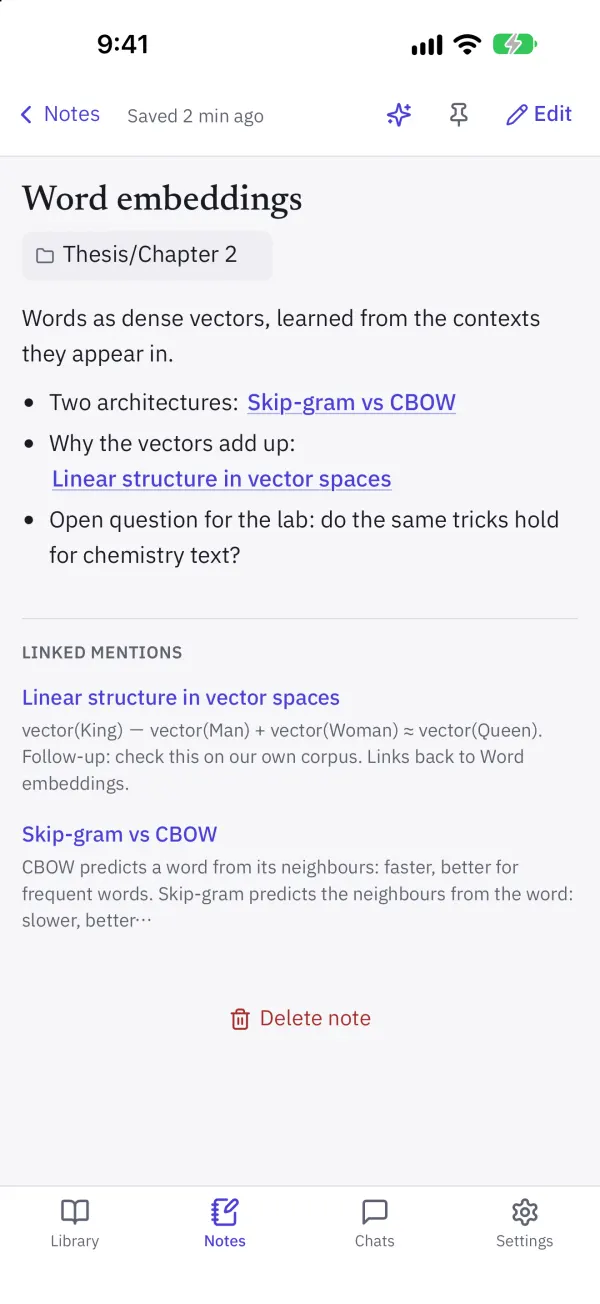
You can also ask questions of one paper, a folder or the whole library, and every answer cites the page it came from, so you can check a claim before it goes into a note. When it’s time to write, the editor’s co-writer drafts and cites only from your own library. If you already keep a Zotero, BibTeX or RIS library, Mitra imports it with your collections as folders. You can download Mitra free and try it on one project’s notes first.
Questions people ask
What should I write down when reading a research paper?
Record the full reference, the question the paper asks, what the authors did, the main result with its numbers, the limitations, and how it relates to your own work. Write these in your own words, not copied sentences. The last item, why it matters to you, is the one people skip and the one that saves the most time later.
What is the difference between literature notes and permanent notes?
Literature notes summarise one source: what this paper says, with page numbers. Permanent notes capture one idea in your own words and can draw on several sources, such as "pretreatment helps fouling only below a certain particle size". Literature notes are a record; permanent notes are the start of your own writing.
Is Zettelkasten worth it for a PhD?
A light version usually is. Writing one idea per note and linking related notes makes literature reviews and discussion sections much easier to draft. A strict version with numbered IDs and rigid rules is rarely worth the overhead; the habit of writing ideas in your own words matters far more than the system.
Where should I keep notes on research papers?
Keep them as close to the papers as you can, ideally in the same tool, so a note always points back to its source. Zotero notes, Obsidian with a citation plugin, and plain Markdown files named by citation key all work. Avoid splitting notes across notebooks, email drafts and sticky notes.