
How Many Papers Should a PhD Student Read Per Week?
Somewhere online, someone is telling you to read three papers a day. Ignore them. There’s no official number, but a sustainable rule of thumb for a PhD student is to skim around 5 to 15 papers a week and read 1 to 3 of them closely. Expect more early on, during the literature review, and fewer during experiments or thesis writing. What matters is reading something most weeks and reading the right papers deeply, not hitting a count.
Below you’ll find honest ranges for each stage of a PhD, what “reading” a paper actually means, the warning signs of too little and too much, and a weekly routine that survives a busy lab schedule.
Why there isn’t one right number
“Three papers a day.” “A hundred papers in your first month.” These describe someone’s habit, not a standard, and they quietly assume you’re that person.
You’re probably not. A computational biologist tracking a fast preprint stream reads very differently from a historian working through archives, and humanities PhDs often read fewer articles and more books. Year one looks nothing like the final six months. Ten 4-page conference papers in your own area are less work than one 60-page theory paper from a neighbouring field.
And then there’s the biggest variable of all: what people mean by “read”. It’s why the numbers people quote never seem to match. So treat every number in this post as a sanity check. If you’re far outside the range, ask why. Don’t ask whether you’re failing.
What counts as “reading” a research paper
Most arguments about how many papers to read are really arguments about what counts. Three levels help:
| Level | Time per paper | What you get | Share of papers |
|---|---|---|---|
| Triage | 1 to 3 minutes | Title, abstract, a glance at figures. Keep or drop? | Most of what you see |
| Skim | 10 to 20 minutes | Question, method, main result, whether it matters to you | A good fraction of what you keep |
| Deep read | 1 to 3 hours, sometimes more | Full understanding, critique, notes you can cite from | A small minority |
The multi-pass method in how to read a research paper quickly maps neatly onto these levels. It’s also the main reason senior people seem to read so much. They don’t. They triage ruthlessly and save deep reading for the papers that earn it.
A shape many people settle into: out of every 50 papers they triage, maybe 10 to 15 get skimmed and 2 or 3 get read deeply. Your ratios will differ. The point is that deep reading is rare on purpose.
How many papers per week, by PhD stage
These ranges are typical for a STEM or social science PhD. They come from common advice and experience, not from any study, so adjust for your field.
First year: building the map. The heaviest reading you’ll do. Many students skim 10 to 20 papers a week and read 2 to 5 closely while writing a first literature review or proposal. You’ll feel you can never catch up. You can’t, and that’s fine: the field is bigger than one person. The goal is to know the main groups, the main methods and the open questions, not every paper. How to write a literature review shows how this reading becomes a chapter.
Middle years: staying current. Once experiments or fieldwork take over, reading drops to maintenance. Triage the week’s alerts, skim 3 to 10, read 1 or 2 deeply when they bear on your work. Some weeks it’ll be zero. That’s acceptable, as long as it doesn’t become every week.
Writing up: targeted reading. In the final stretch, most reading is checking. You re-read key papers to cite them correctly, fill the specific gaps a chapter exposes, and do one last sweep for anything published since your review. Fewer papers, sharper focus.
Across the whole degree, many PhD students skim several hundred papers and read perhaps a hundred or so in real depth. Thesis bibliographies often land somewhere around 100 to 300 references, varying a lot by field and format. How many sources for a literature review digs into those numbers.
Signs you’re reading too little, or too much
Counting papers tells you less than watching for symptoms.
You’re probably reading too little if your supervisor or a reviewer mentions a well-known paper in your area and you’ve never heard of it. Or if you can’t name the three or four groups doing the work closest to yours. Or if your research question was fixed in year one and you’ve never checked whether someone has since answered it.
You’re probably reading too much if weeks have passed without a single paragraph written or a single analysis run. If every paper leads to five more and no thread ever closes. If reading feels like progress but you can’t say what you’d do differently because of it.
The second set is more common than people admit. Reading is comfortable. Writing and experiments are not. If that’s you, cap the reading and set a small writing target instead; how to write every day in a PhD has a routine that helps.
A weekly reading routine you can sustain
A routine beats bursts. This one fits around a full lab or teaching week, about three hours in total.
- Monday, 20 minutes: triage. Go through the week’s alerts: Google Scholar alerts, journal tables of contents, arXiv or bioRxiv listings, your RSS reader. Titles and abstracts only. Keep 5 to 10. How to keep up with research literature covers setting up those feeds.
- Tuesday and Thursday, 40 minutes each: skim. Three or four of the kept papers per session. Write two lines for each: what they found, and whether it matters to you. Drop the rest without guilt.
- Wednesday or Friday, 90 minutes: one deep read. The single most relevant paper of the week. Read it properly, argue with it, write a full note. Guard this block like a meeting with your supervisor.
- Friday, 10 minutes: file and pick. Move everything into your library, tag it, choose next week’s deep read.
That’s roughly 6 to 8 skims and one deep read a week, comfortably inside the ranges above. In heavy reading phases, add a second deep read. In crunch weeks, keep only the Monday triage so the habit doesn’t snap.
Here’s how that plays out. Say you’re a second-year PhD student in environmental engineering, and your alerts bring in about 60 new titles a week. Triage cuts that to 8. Skimming cuts it to 2 worth a proper note. One gets the deep read because it uses the groundwater sampling method you’re about to adopt. Over a 44-week working year, that’s about 2,600 titles triaged, around 350 papers skimmed, and about 44 read in depth. No single week felt heavy.
Making the reading count
Reading only helps if you keep what you read. Three habits matter more than the count.
Write something for every paper past triage: two lines for a skim, a full note for a deep read. How to take notes on research papers has a template you can copy. Keep one library, too. Papers scattered across Downloads, email attachments and a folder called papers_new_FINAL are papers you’ll end up reading twice by accident, so it’s worth learning how to organize research papers early.
And talk about what you read. Explaining a paper at journal club, or to your supervisor over coffee, fixes it in memory far better than a second read ever will.
Where Mitra fits
Mitra is a free desktop app for macOS, Windows and Linux, and your papers stay on your own computer. It handles the parts of a reading routine that aren’t reading. It can watch your Downloads folder and add new papers to your library automatically, catch duplicates, and give main.pdf its real title, which takes care of most of that Friday filing. Its Find papers feature searches the literature for new papers on a topic, if you want to top up Monday’s triage list.
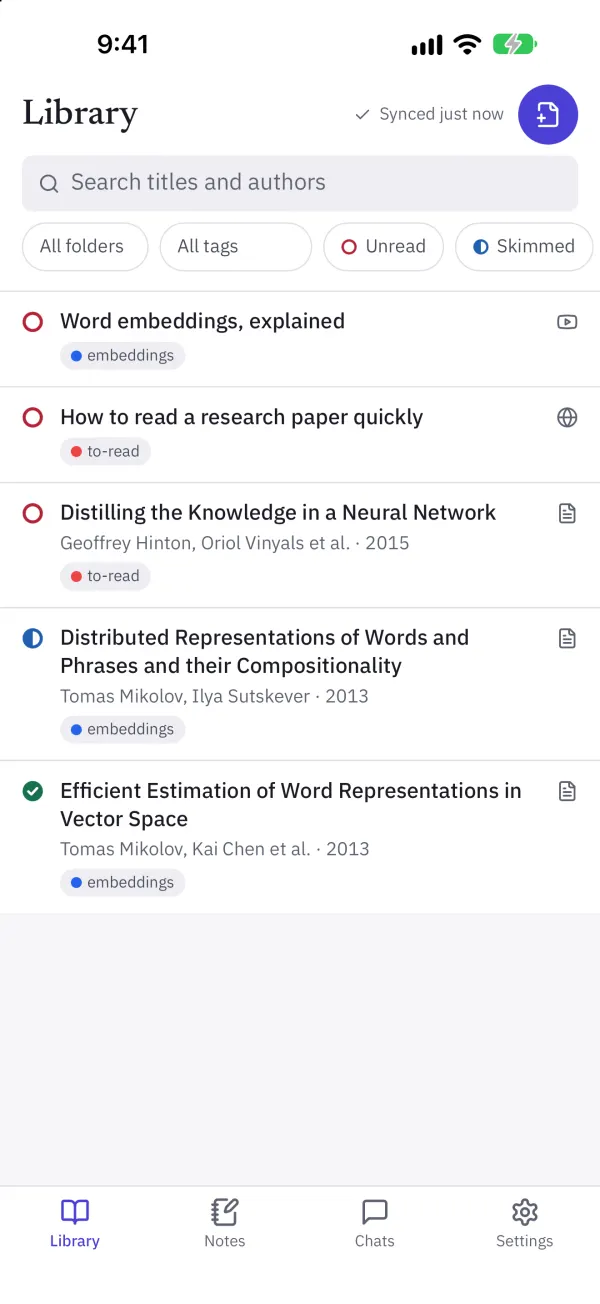
For skims, you can ask a paper a quick question, like “what was the method and main result?”, and the answer cites the page it came from. That’s often enough to decide in a minute whether something deserves the Wednesday slot. Highlights and notes from your deep reads stay searchable across the whole library. Download Mitra free and set it up around the routine above.
Questions people ask
How many papers should a PhD student read per week?
There is no official number, but a common and sustainable pattern is to skim around 5 to 15 papers a week and read 1 to 3 of them closely. Early in the PhD, during the literature review, the numbers are higher; during heavy experimental or writing phases they drop. Consistency matters more than the count.
How many papers does a PhD student read in total?
It varies widely by field and topic. Many PhD students skim several hundred papers over the degree and read perhaps a hundred or so in real depth, while a thesis bibliography often lands somewhere between about 100 and 300 references. Treat these as rough ranges, not targets.
Is it normal to not read every paper fully?
Yes. Most experienced researchers read the title and abstract of many papers, skim the figures of fewer, and read only a small fraction from start to finish. Deciding quickly which papers deserve a full read is a core research skill, not a shortcut.
How long should it take to read a research paper?
A first skim takes 5 to 15 minutes. A careful read of a paper in your own area often takes one to two hours, and a paper you plan to build on or replicate can take several sessions over days. Papers outside your field take longer.