
How to Summarize a Research Paper: Template and Example
Your supervisor leans back and asks, “So what did the Lindqvist paper actually find?” You read it three weeks ago. You remember the font. You remember it was “really relevant”. The finding itself has gone.
A short written summary would have saved you. To summarize a research paper, write one sentence saying what the authors did and what they found, then grow it into a paragraph covering the question, the method, the main result with its numbers, the main limitation, and why it matters. Use your own words, not the abstract’s. A good summary lets someone who hasn’t read the paper decide whether they need to, and that someone is often you.
This post covers the one-sentence summary, the one-paragraph version, a fill-in template, a worked example, and the habits that make summaries useless when you come back to them.
Read the paper before you summarize it
A summary written during the first read is usually a paraphrase of the abstract. That’s not worthless, but it’s a summary of the authors’ pitch, not of the paper.
Write yours after at least a second pass, once you’ve looked at the figures and know what the results actually show. How to read a research paper quickly covers the multi-pass approach if you need a way to get there fast. Then close the PDF before you start writing. If you can’t summarize it without peeking, you’ll find out exactly which part you didn’t understand. That’s the most valuable thing a summary does, and it happens before you’ve written a word worth keeping.
How to summarize a paper in one sentence
Start here. Everything else hangs off this sentence, and it has a simple shape:
[Who] [did what, to what or whom] and found [main result, with a number if possible].
A few examples (the papers are made up):
- “Nguyen et al. ran 30-day bench tests of ozone pretreatment on ceramic membranes using river water and found flux decline fell from about 40% to 15% at a moderate dose.”
- “Lindqvist and Lind interviewed 26 first-generation PhD students in the UK and found that unclear expectations about supervision, more than money, drove thoughts of leaving.”
- “A transformer model trained on 1.2 million radiology reports matched senior radiologists’ F1 score on one hospital’s test set but dropped 9 points on a second hospital’s data.”
Each one names the method in a few words, gives the setting, and states the finding concretely. The third packs the limitation into the sentence itself, because for that paper the limitation is the story.
What not to write: “This paper investigates the role of X in Y.” That’s the topic, not the finding. You can’t cite a topic, and you can’t answer your supervisor with one either.
The one-paragraph summary
The paragraph adds what the sentence had to leave out. Aim for 100 to 200 words, roughly in this order: the question and why it matters, in a sentence; the approach, meaning design, data or sample, and key method, enough that someone in your field could judge it; the main result with its numbers and what it was compared against; secondary results, only if they matter to you, one sentence at most; the limitations, the biggest one or two; and the significance, what this changes for the field or for you.
On limitations: not the ones the authors listed to sound modest. The ones that actually limit the conclusion. How to read a paper critically gives you the questions that dig those up.
Those last two items are what separate your summary from the abstract. If your paragraph has no limitation and no judgement, it’s an abstract with fewer words.
A research paper summary template
Copy this into your notes and fill it in. It works for most empirical papers.
Reference: Author(s), Year. Title. Journal. DOI.

One sentence: [Who] [did what] and found [result, with numbers].

Question:
Approach (design, sample/data, method):
Main result (numbers, comparison):
Limitations:
Why it matters (field):
Why it matters (me):
Pages worth returning to:
“Why it matters (me)” is the line everyone skips and the one that saves the most time later. “Possible baseline for my chapter 3 experiment” or “contradicts Smith 2019, need to check sample sizes” will mean something in six months. “Interesting” won’t. Neither will “really relevant”.
For a full note-taking setup around this, including where to keep summaries so they stay attached to their PDFs, see how to take notes on research papers.
A worked example of a research paper summary
Here’s the template filled in for the Lindqvist paper your supervisor asked about. It’s hypothetical; every detail is invented for illustration.
Reference: Lindqvist, A. & Lind, S. (2024). Why first-generation doctoral
students consider leaving. <journal>. <doi>.

One sentence: Lindqvist and Lind interviewed 26 first-generation PhD
students at four UK universities and found that unclear supervision
expectations, more than finances, drove thoughts of leaving.

Question: Why do first-generation doctoral students consider leaving,
and how does this differ from what universities assume (mainly money)?

Approach: Semi-structured interviews (45-70 min), 26 students in
years 1-3, social sciences and STEM, thematic analysis by two coders.

Main result: 19 of 26 described a period of seriously considering
leaving. The most common theme was not knowing what supervisors
expected (mentioned by 17), ahead of financial stress (11).

Limitations: Recruited through student networks, so likely skewed
towards students who were engaged enough to volunteer. No comparison
group of continuing-generation students, so we can't tell whether the
pattern is specific to first-generation students.

Why it matters (field): Suggests induction and supervision agreements
may matter as much as bursaries.

Why it matters (me): Fits my chapter 2 argument about tacit norms.
Need a comparison-group study to pair it with.

Pages: p. 9-11 (supervision theme, best quotes), Table 2 (themes).
And the paragraph version, the one you could paste into a draft or a reading list:
Lindqvist and Lind (2024) interviewed 26 first-generation PhD students at four UK universities to understand why they consider leaving. Most (19 of 26) described seriously considering it, and the most common reason was not knowing what their supervisors expected, mentioned by 17 participants, ahead of financial stress. The study has no comparison group of continuing-generation students, so it can’t show the pattern is specific to first-generation students, and volunteers may differ from those who didn’t take part. Still, it suggests that clear supervision expectations deserve as much attention as funding in retention efforts.
Under 100 words. Anyone reading it knows what the study did, what it found, how far to trust it, and why you cited it. Including you, three weeks from now, in that meeting.
Adjusting the summary to its purpose
The same paper needs a different summary depending on where it’s going.
| Purpose | Length | What to stress |
|---|---|---|
| Your own notes | 1 sentence + template | Numbers, limitations, link to your work |
| Journal club or lab meeting | 3 to 5 minutes spoken | Question, one key figure, what you’d question |
| Class assignment | Usually 250 to 500 words, follow the brief | Structure, accuracy, neutral tone |
| Literature review | 1 to 3 sentences | How it relates to other papers |
| Annotated bibliography | 100 to 200 words | Summary plus evaluation |
The literature review is the odd one out. There you rarely summarize papers one at a time; you group them by finding or method and summarize the group. How to synthesize literature for a review shows how individual summaries turn into those grouped paragraphs.
Common mistakes in research paper summaries
The most common is copying the abstract. It skips the limitations, reads like the authors’ pitch, and if it slips into your draft unchanged, it’s a plagiarism problem too. Next is leaving out the numbers: “improved performance” can’t be cited or compared, so write the figure and what it beat. Some summaries describe the paper’s structure (“Section 2 reviews the literature, section 3 presents the method…”), which tells the reader nothing about what was found. Others try to cover everything; a paper with eight results usually has one or two that matter, so pick them. And plenty forget the citation details. Put the DOI or full reference on the first line, or enjoy the hunt later.
Using AI to summarize a research paper
ChatGPT, Claude and similar tools can produce a passable summary in seconds. The catch is that they sometimes state results, sample sizes or conclusions the paper doesn’t contain, and they tend to echo the abstract’s confidence. Ask one about the Lindqvist paper and you might get “first-generation students leave primarily because of poor supervision”, which sounds right and isn’t: nobody in the study left, they considered leaving, and there’s no comparison group behind “primarily”.
So treat the output as a draft. Check every number against the paper, add the limitation it probably left out, and rewrite it in your own words. How to use AI for research without fake citations covers the checks in more detail.
Where Mitra fits
Mitra is a free desktop app for macOS, Windows and Linux, and your papers and notes stay on your own computer. You can read a paper in its PDF reader, highlight the result and limitation sentences, and keep your summary as a note right alongside them.
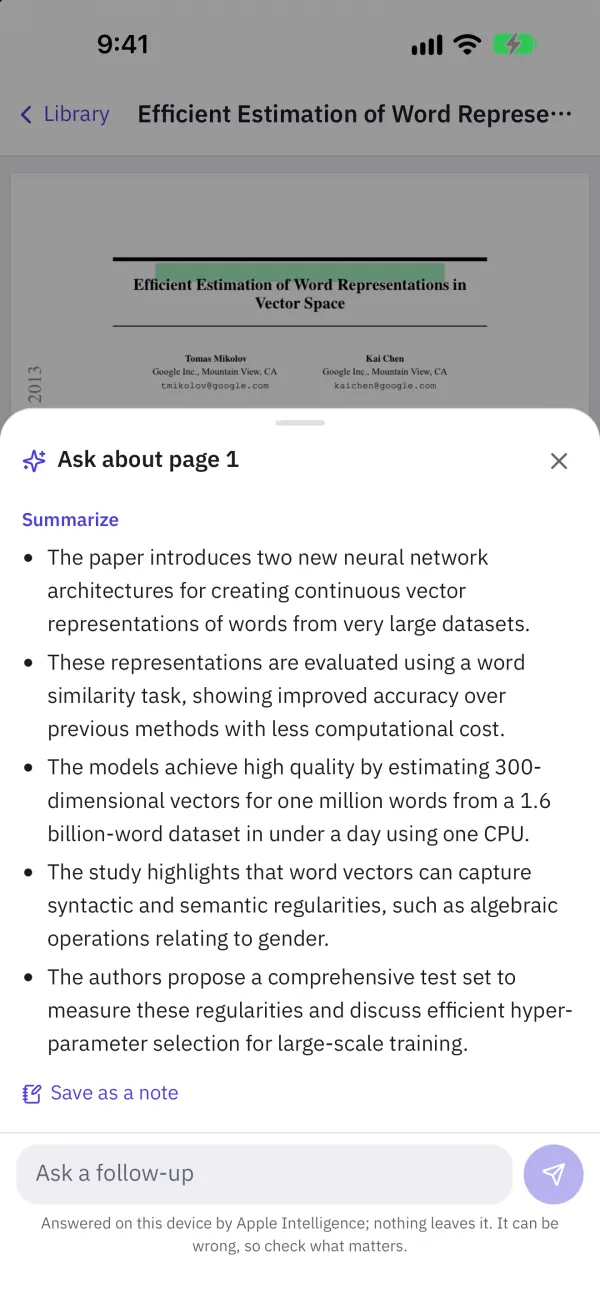
If you want a starting draft, ask Mitra about one paper, for example “what was the sample and the main result?”, and each statement in the answer cites the page or section it came from. One click takes you to the passage, so checking a number takes seconds, not a re-read. Asking across a folder (“summarize what these five papers found about fouling”) gives you a cited first pass at the grouped summary a literature review needs. You can download Mitra free and try it on the papers you need to summarize this week.
Questions people ask
How long should a summary of a research paper be?
It depends on the use. For your own notes, one sentence plus a paragraph of 100 to 200 words is usually enough. For a class assignment, follow the brief, which is often 250 to 500 words. In a literature review, a single paper rarely gets more than two or three sentences.
What should a research paper summary include?
The research question, what the authors did, the main result with its key numbers, the main limitation, and why it matters. For a summary written for yourself, add one line on how the paper relates to your own work. Leave out background the reader already knows and minor results.
Is a summary the same as an abstract?
No. The abstract is written by the authors to sell the paper, so it stresses strengths and new contributions. Your summary is written for a reader, often yourself, and should include the limitations and your judgement of how strong the evidence is.
Can I use AI to summarize a research paper?
You can use it as a first draft, but check every number and claim against the paper, because AI summaries can state results the paper never reported. Tools that cite the page for each statement make checking much faster. Then rewrite the summary in your own words, since writing it is what makes you understand the paper.